The Dead Moons of Aldebaran b
Benjamin Pope
NASA Sagan Fellow, NYU
benjaminpope.github.io/talks/aot/aot
Aldebaran
α Tauri
الدبران ,the follower
Hatzes & Cochran, 1993 claimed a detection of a \(628.96 \pm 0.90\) d planet around Aldebaran
finally confirmed in Hatzes et al., 2015!
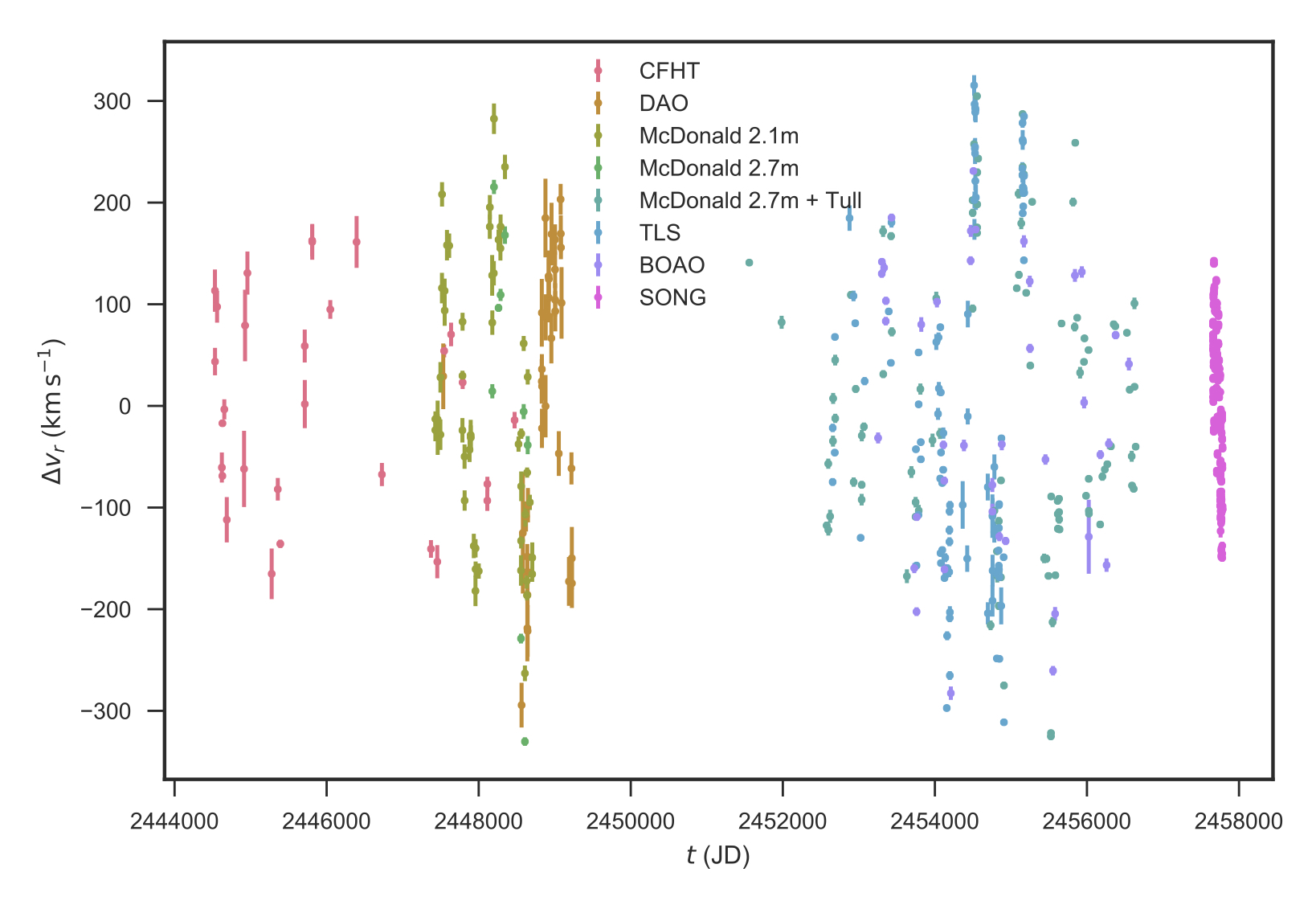
A reanalysis of this data by Will Farr (Flatiron) detects additional variation with a ~ 6 day period
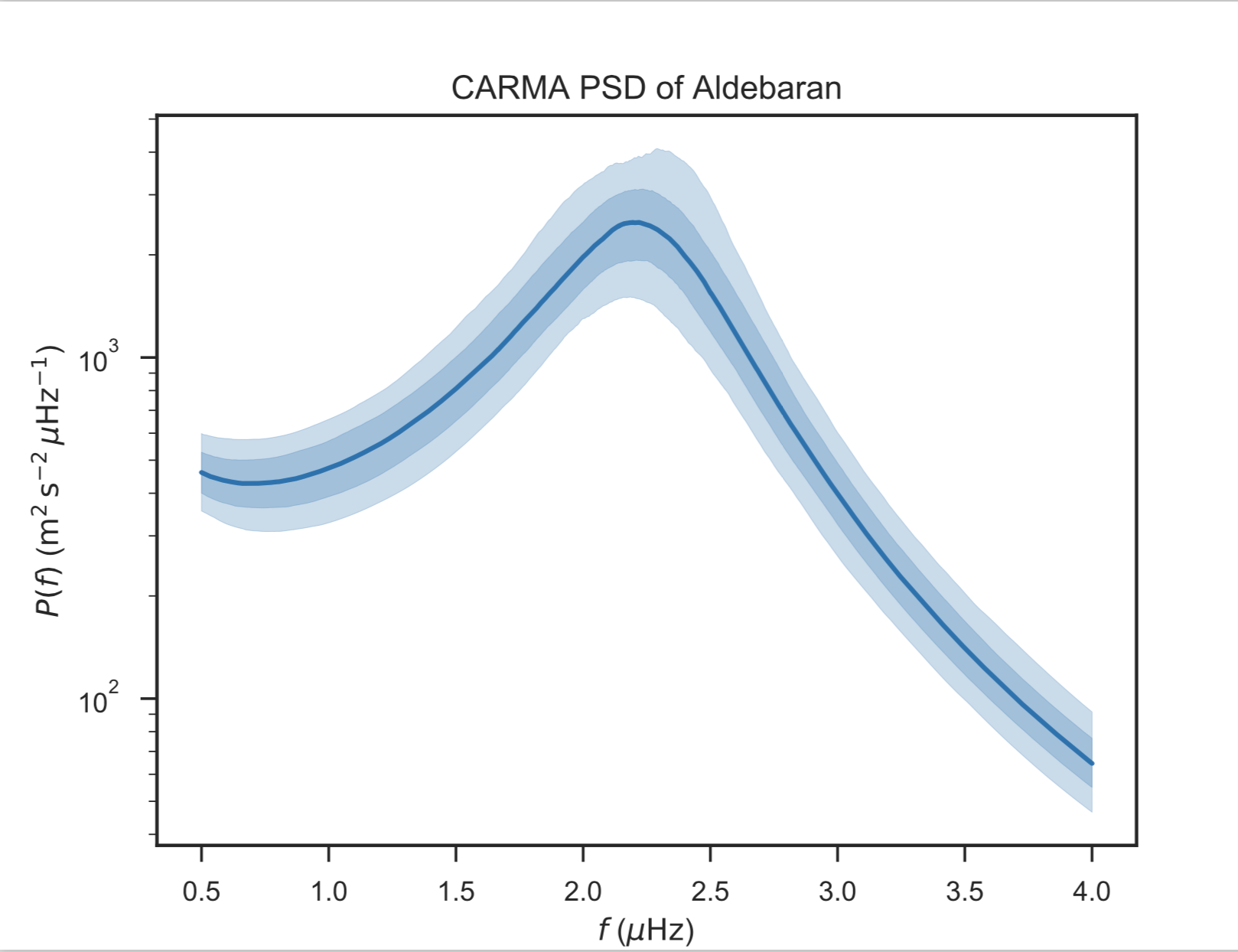
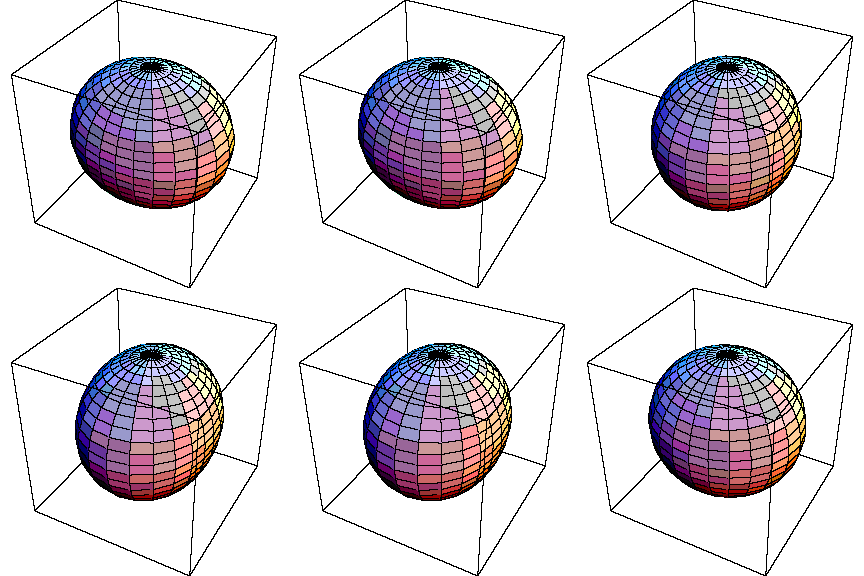
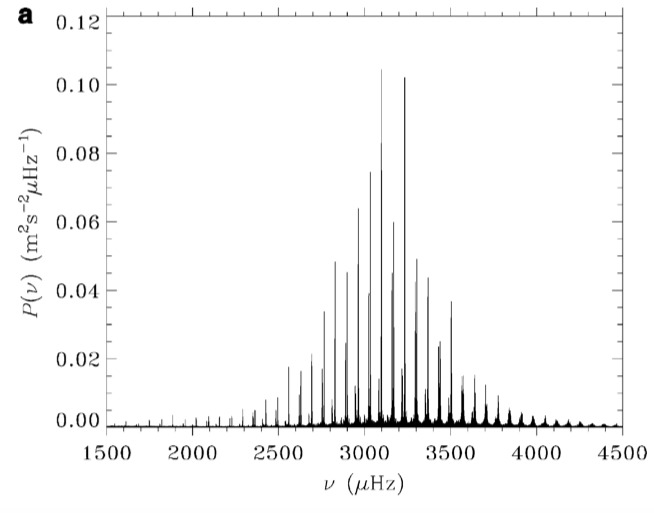
Their frequencies tell us about stellar interior structure.
Frequencies of the Sun's 5-minute oscillations
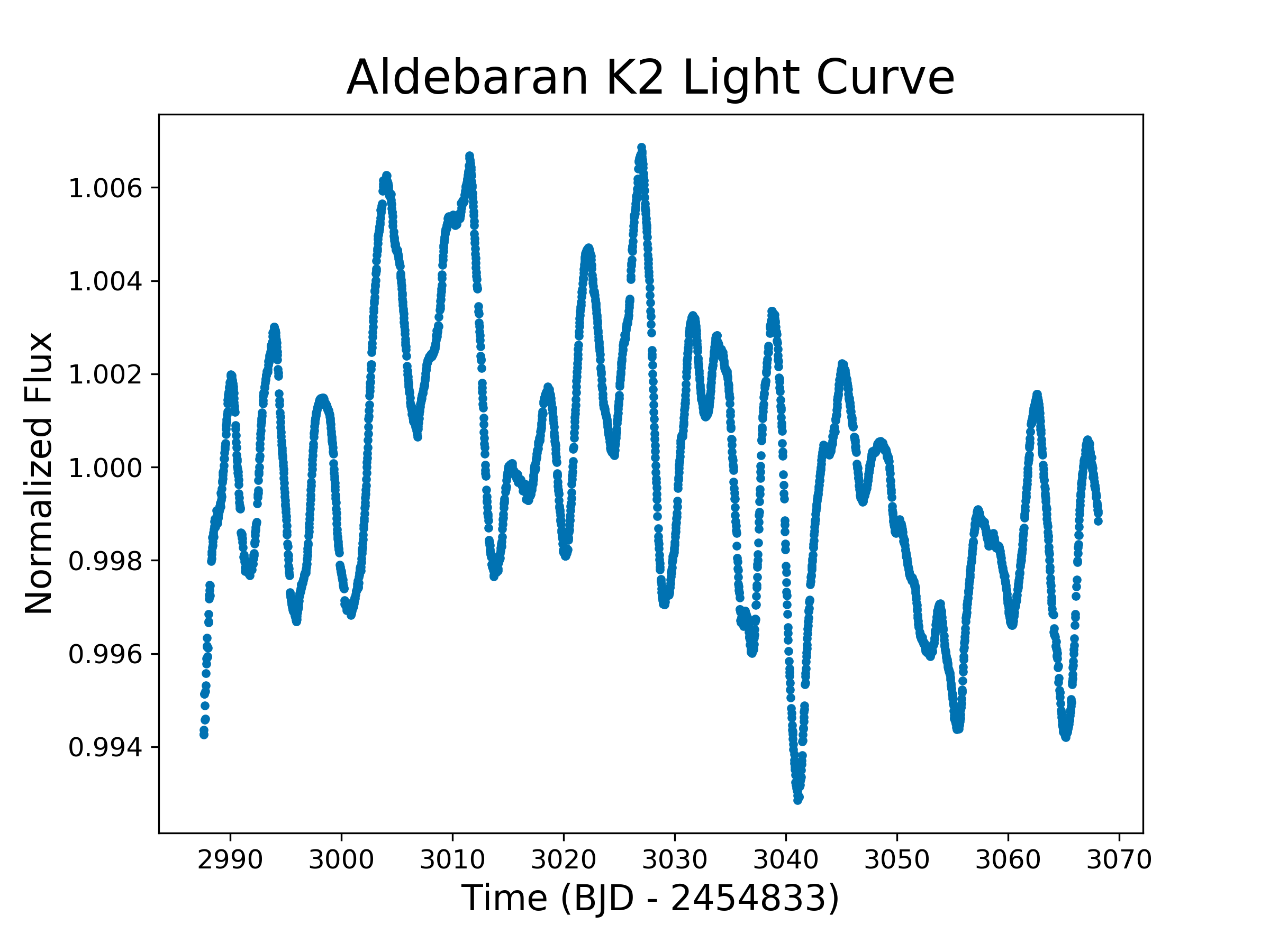
Can we confirm this with Kepler?
Too bright to look at with Kepler!
Yes! We get the same frequency with K2!
\[M = 1.27^{+0.24}_{-0.20} \, \mathrm{M_{\odot}}\] and age \(4.9^{+3.6}_{-2.0} \, \rm Gyr \)
\[M = 1.16^{+0.07}_{-0.07} \, \mathrm{M_{\odot}}\] and age \(6.4^{+1.4}_{-1.1} \, \rm Gyr \)
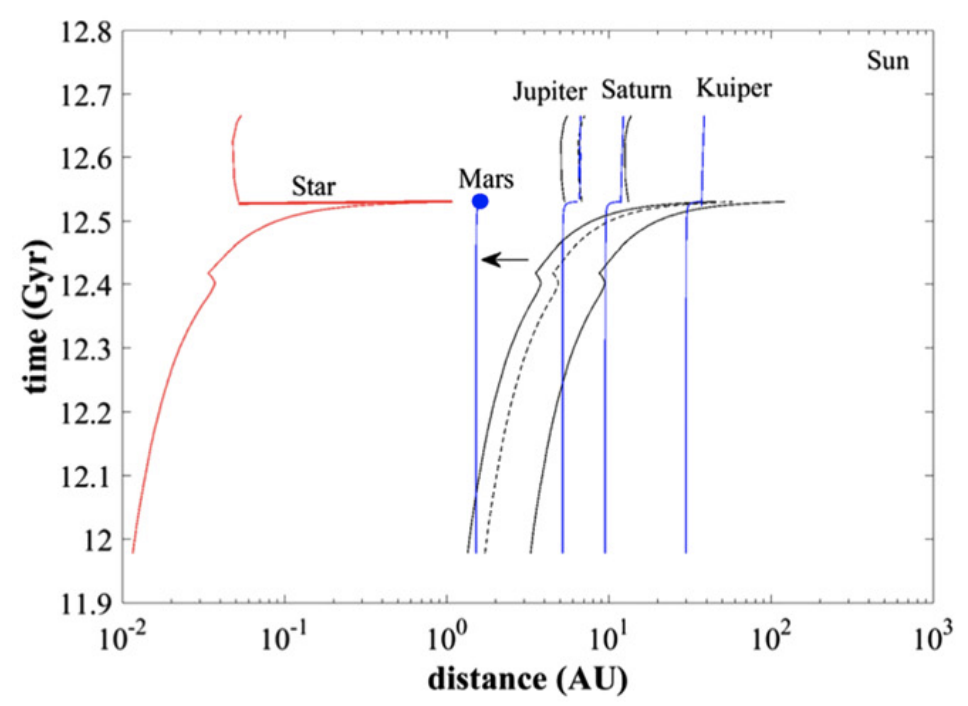
Fitting stellar models, we find that on the main sequence Aldebaran b orbited at \(1.50 \pm 0.03 \) AU and the star had a luminosity \(2.0 \pm 0.7 \, L_\odot \)...
so Aldebaran b had an insolation comparable to Earth when its star was on the main sequence.