Finding Transiting Exoplanets
The Data Challenge
Benjamin Pope, NYU
benjaminpope.github.io/talks/ranganath/ranganath.html
Transiting Planets
Exoplanet-style transit light curve of Venus from James Gilbert on Vimeo.
The best options are those around bright stars, like 55 Cancri e - subject of 367 papers in the last decade!
Kepler Photometry
but the pixels have different gains ("inter- and intra-pixel sensitivity variation")...
and the pixel window doesn't necessarily track the whole PSF perfectly ("aperture losses").
Raw - GP in position - GP in time
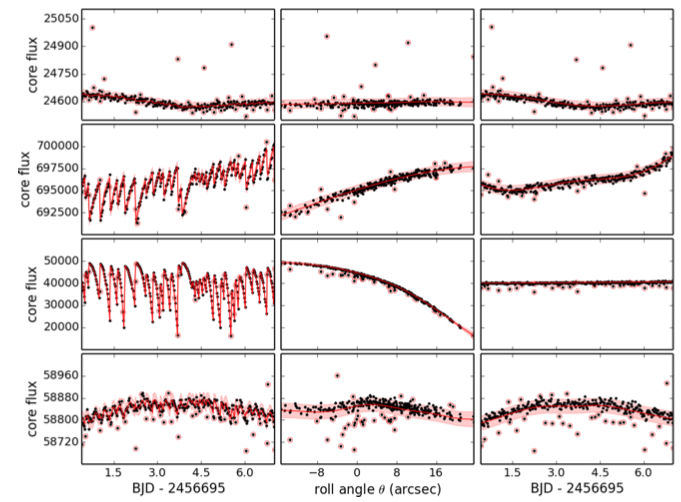
By subtracting the GP time and spatial components, we can find a transiting planet!
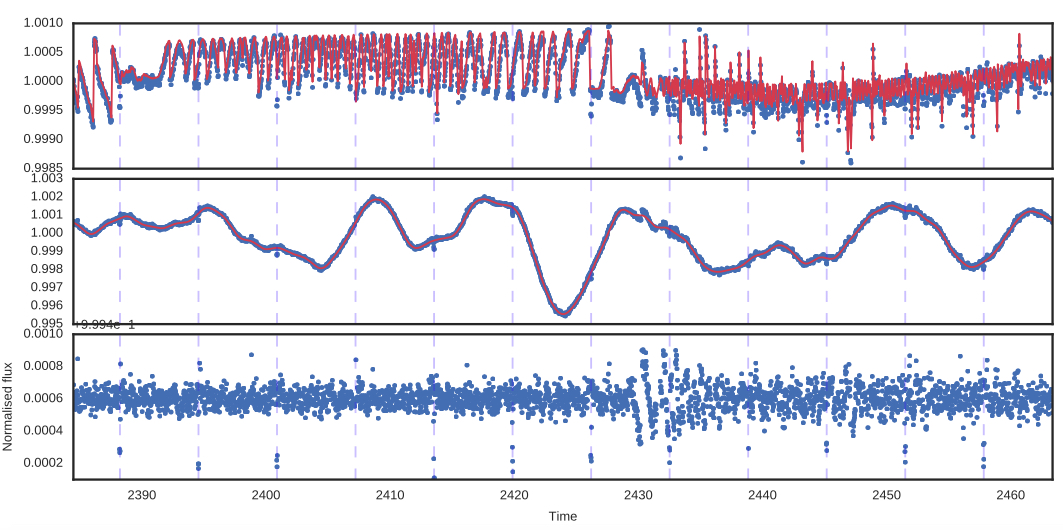
We will be motivated by this here.
Halo Photometry
\[ f_i \equiv \sum\limits_i w_j p_{ij} \]
\[\begin{align} TV \equiv \sum_i |f_i - f_{i-1}| \end{align} \] subject to constraints \[\begin{align}\forall_j w_j &> 0\\ \sum_{i=1}^{N} f_i &= N.\end{align} \]
This is the \(L_1\) norm or 'taxicab metric' on the derivative of the time series.
This has analytic derivatives you can compute with autograd - easy to optimize.
\[\begin{align} TV_δ \equiv \sum_i |f_{i} - f_{i-δ}| \end{align} \]
We can also generalize the \(L_1\) norm to the \(L_k\) norm \[Q_{k,\delta} \equiv {\sum_i{|f_i - f_{i-\delta}|^k}}\]
This has analytic derivatives you can compute with e.g. autograd - easy to optimize.
But they're sparse in the Fourier domain... perhaps this is relevant?
All K2 Halo data are available online at github.com/benjaminpope/k2halo
The Future
We need your help to be able to understand and improve photometry tools.