Finding Exoplanets around Bright Stars
Benjamin Pope
NASA Sagan Fellow, NYU
Dunlap Seminar
benjaminpope.github.io/talks/toronto/toronto
Transiting Planets
Exoplanet-style transit light curve of Venus from James Gilbert on Vimeo.
The best options are those around bright stars, like 55 Cancri e - subject of 367 papers in the last decade!
Asteroseismology
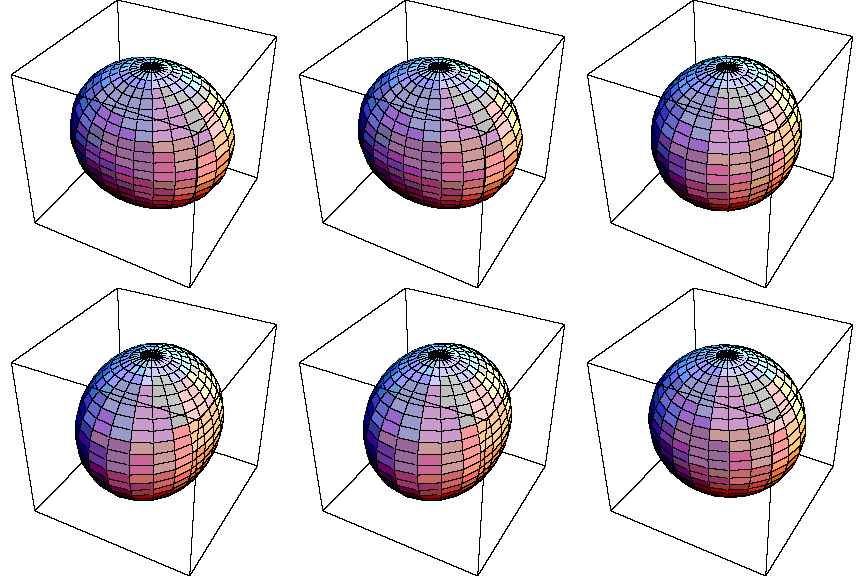
Their frequencies tell us about stellar interior structure.
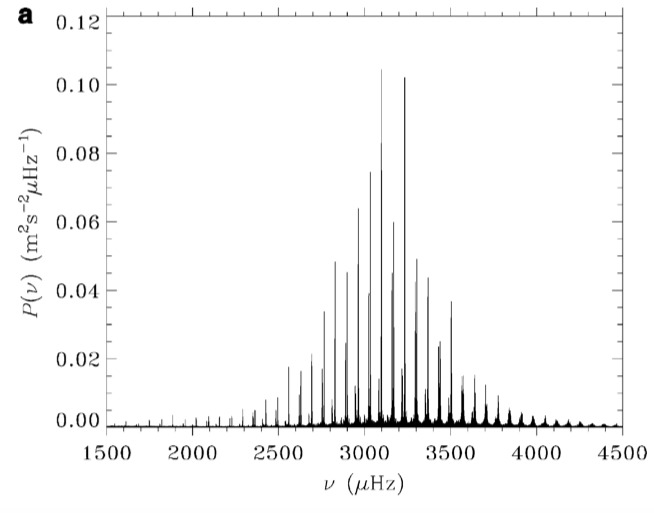
Power spectrum of the Sun's 5-minute oscillations
Kepler Photometry
but the pixels have different gains ("inter- and intra-pixel sensitivity variation")...
and the pixel window doesn't necessarily track the whole PSF perfectly ("aperture losses").
Halo Photometry
\[ f_i \equiv \sum\limits_i w_j p_{ij} \]
\[\begin{align} TV \equiv \dfrac{\sum_i |f_i - f_{i-1}|} {\sum_i f_i } \end{align} \]
This is the L1 norm on the derivative of the time series.
This has analytic derivatives you can compute with autograd - easy to optimize.
But they're sparse in the Fourier domain... perhaps this is relevant?
Pleiades
Πλειάδες, the Seven Sisters
Alcyone, Atlas (dad), Electra, Maia, Merope, Taygeta, Pleione (mum)
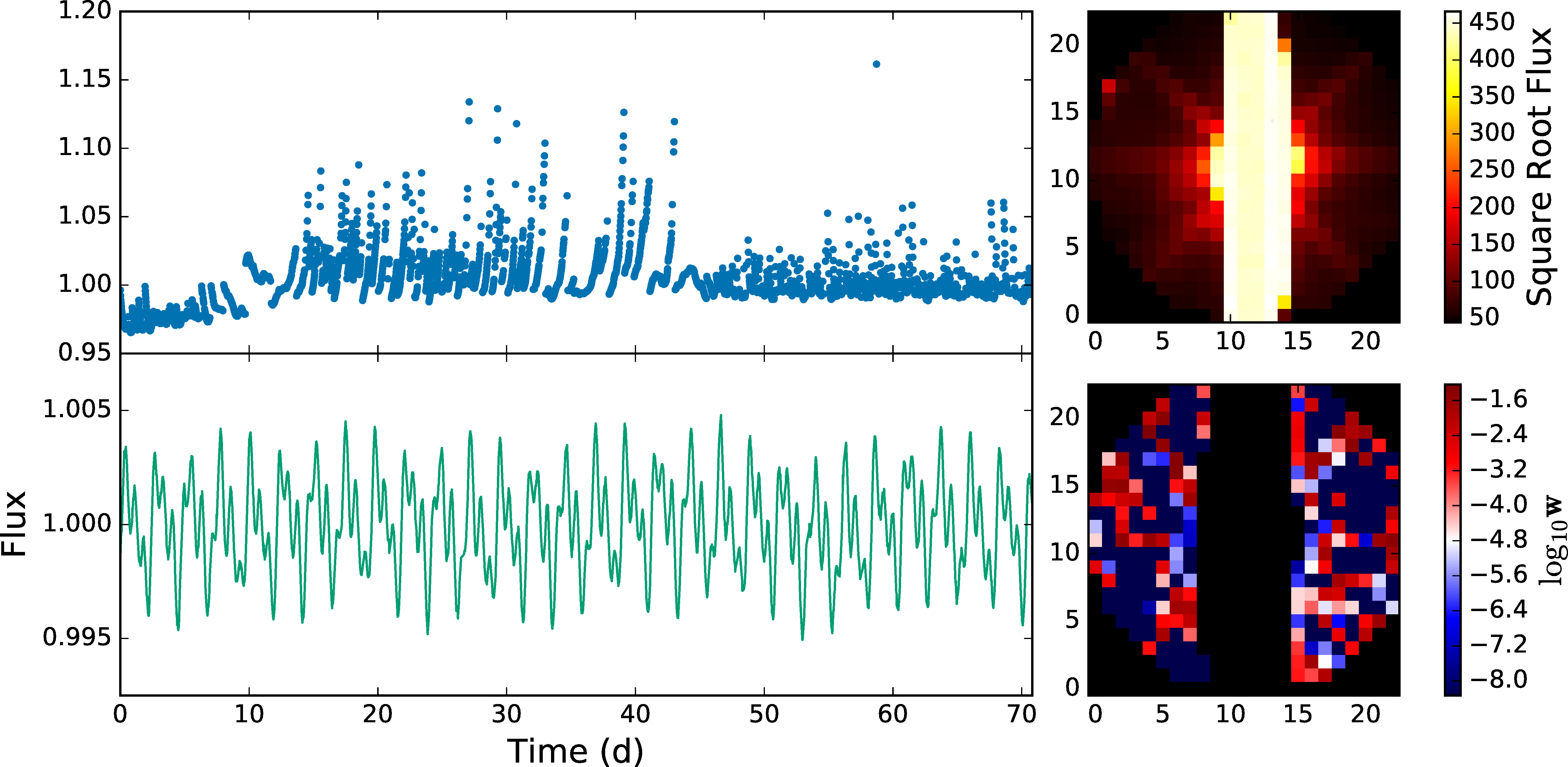
Atlas lightcurve: raw (top) and halo (bottom)
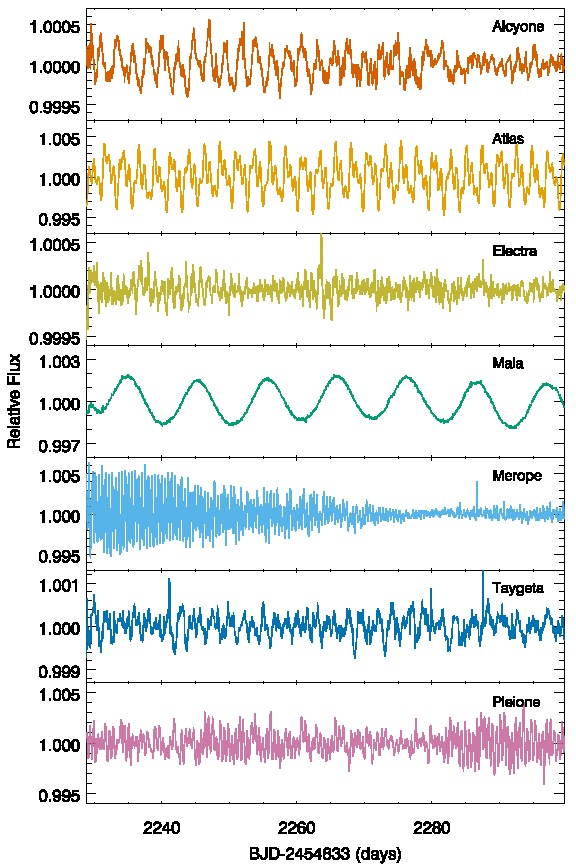
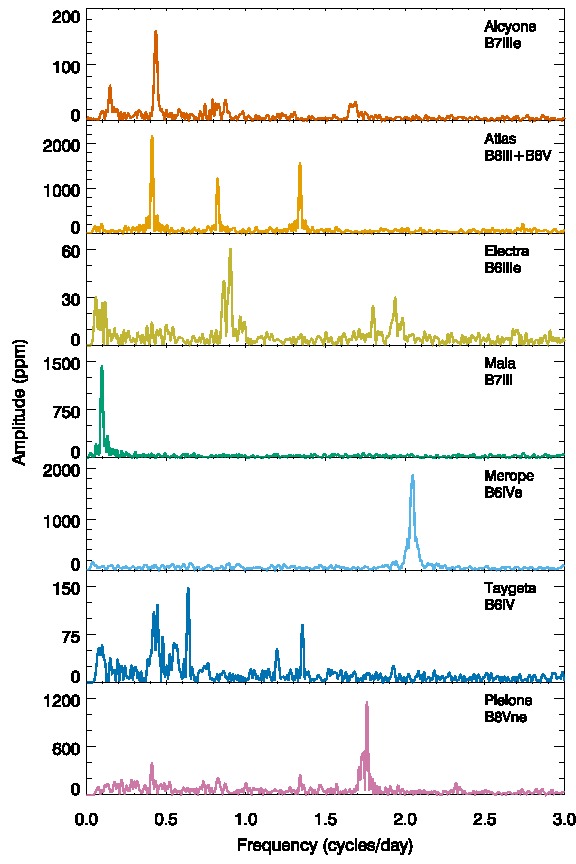
Lightcurves of All Seven Bright Pleiades
I am currently searching all bright stars in K2 for transiting planets - none so far, but plenty of asteroseismology!
Aldebaran
α Tauri
الدبران ,the follower
... follows the Pleiades!
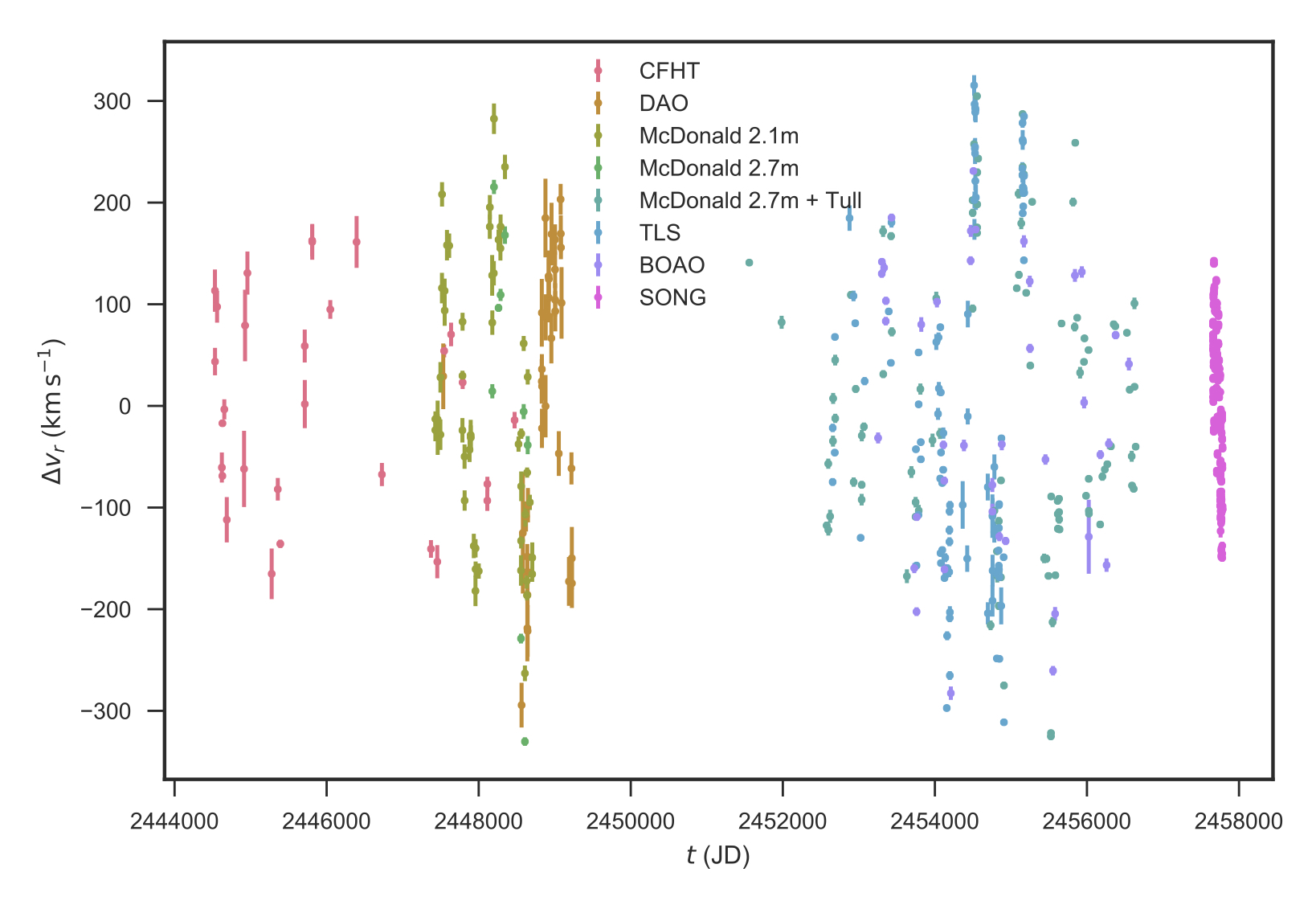
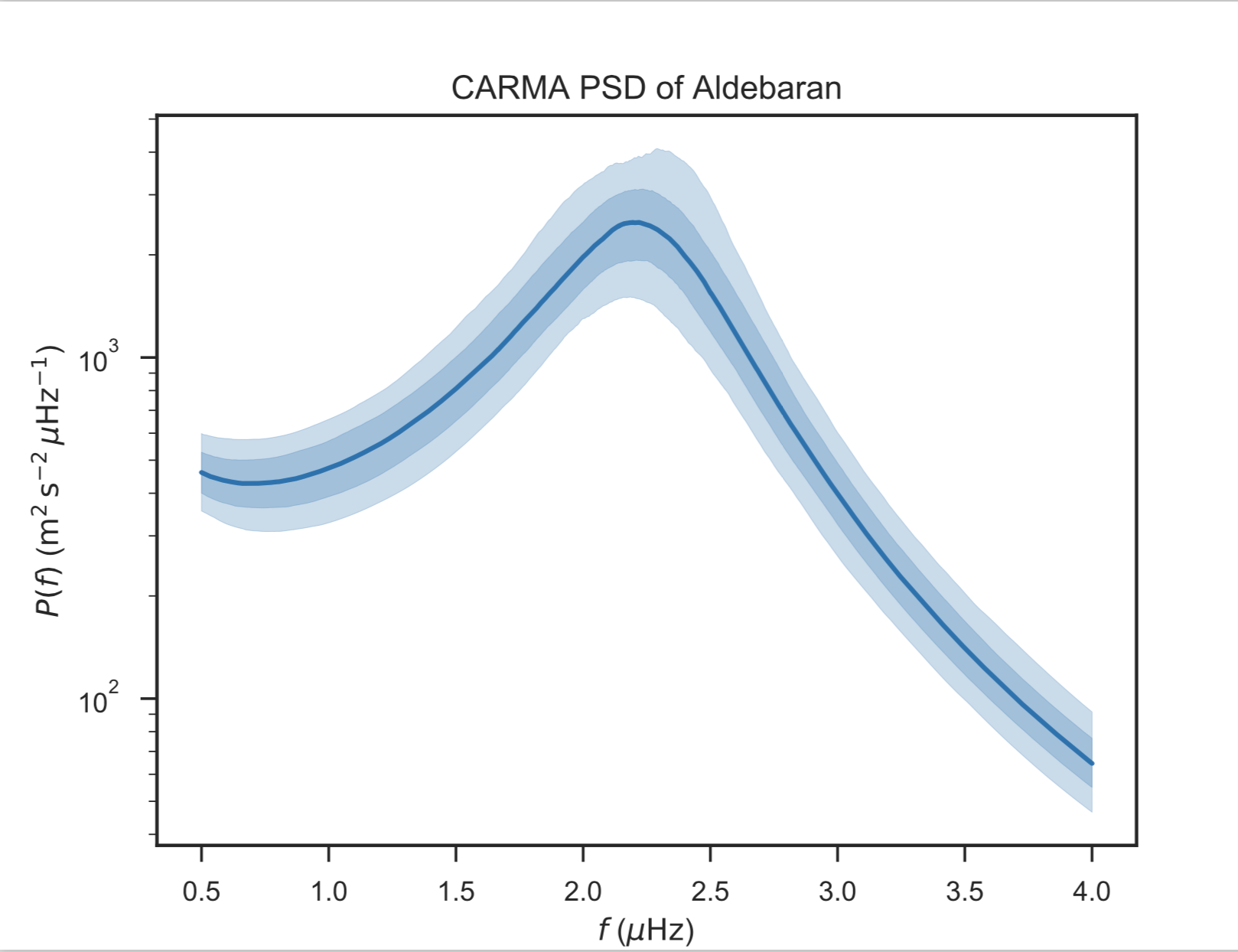
Yes! We get the same frequency with K2!
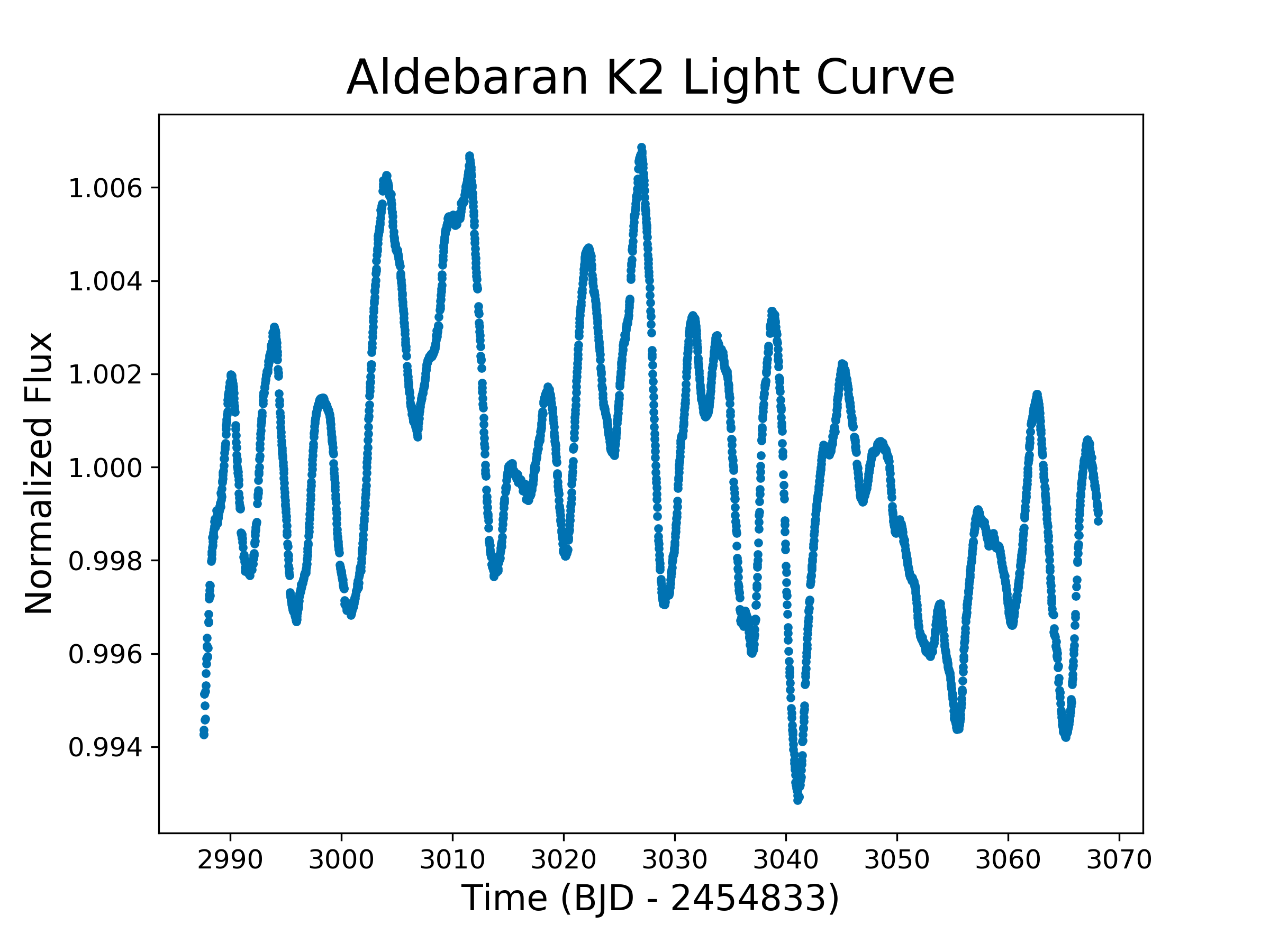
\[M = 1.27^{+0.24}_{-0.20} \, \mathrm{M_{\odot}}\] and age \(4.9^{+3.6}_{-2.0} \, \rm Gyr \)
\[M = 1.16^{+0.07}_{-0.07} \, \mathrm{M_{\odot}}\] and age \(6.4^{+1.4}_{-1.1} \, \rm Gyr \)
Using MESA models, we find that on the main sequence Aldebaran b had a semi-major axis of \(1.50 \pm 0.03 \) AU and Aldebaran had a luminosity \(2.0 \pm 0.7 \, L_\odot \)...
so Aldebaran b had an insolation comparable to Earth when its star was on the main sequence.
The Future
Let's collaborate!