Planets and their Host Stars

Benjamin Pope, NYU

UQ Seminar

Slides available at
benjaminpope.github.io/talks/uq/uq

Transiting Planets

Exoplanet-style transit light curve of Venus from James Gilbert on Vimeo.

Large searches for exoplanets like the Kepler mission have shown planets to be common in our Galaxy - now we want to learn about their atmospheres and compositions.

The best options are those around bright stars, like 55 Cancri e - subject of 367 papers in the last decade!

My Sagan Fellowship project is to search for planets transiting naked-eye stars (V mag < 6.5) in order to find ideal targets for characterization with the upcoming James Webb Space Telescope.

Asteroseismology

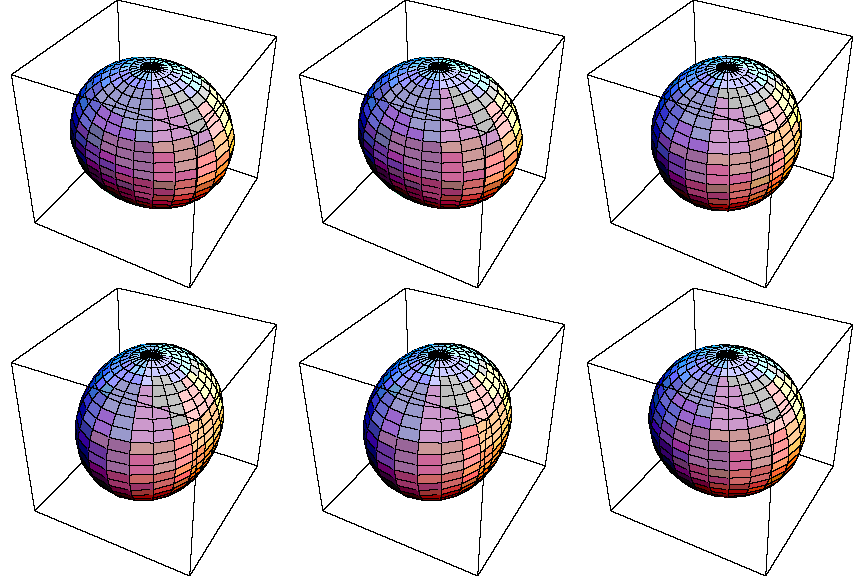
Stars ring like bells, with acoustic and buoyancy oscillations.

l=2, m=2 oscillation

Their frequencies tell us about stellar interior structure.

Power spectrum of the Sun's 5-minute oscillations
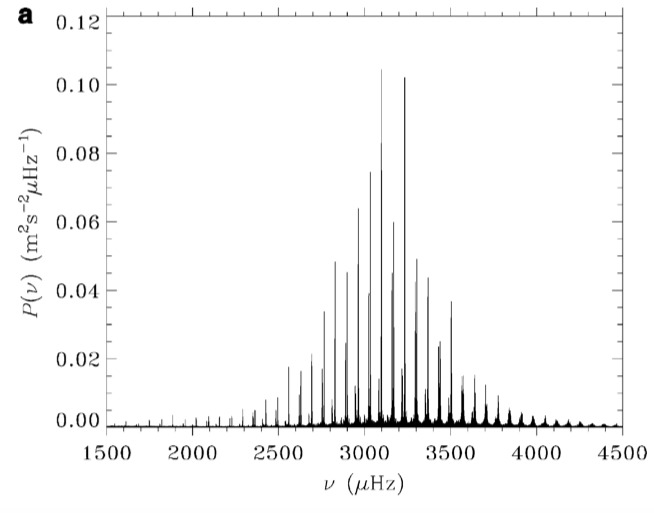
Helioseismic Power Spectrum

Kepler Photometry

The Kepler Space Telescope, launched in 2009, looks for planets by the transit method, and also does asteroseismology.
After the failure of a reaction wheel in 2012, it is now operating as the 'K2 Mission', with very unstable pointing (hence the shaking in the videos you'll see).
To get the photometry, you can just sum the pixel values in a window containing the whole PSF...

but the pixels have different gains ("inter- and intra-pixel sensitivity variation")...

and the pixel window doesn't necessarily track the whole PSF perfectly ("aperture losses").

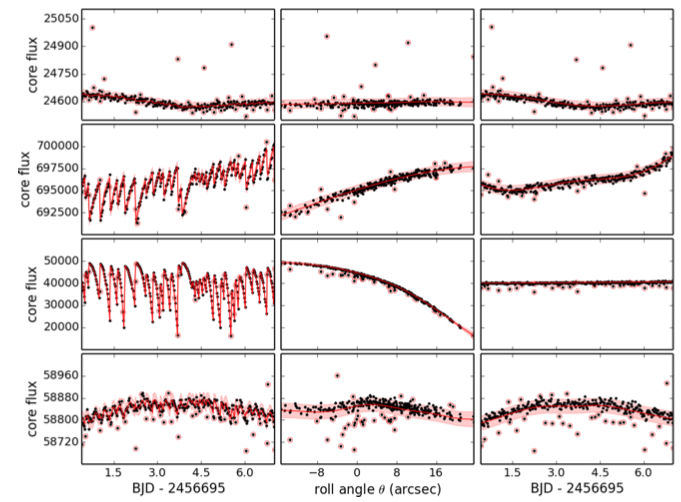
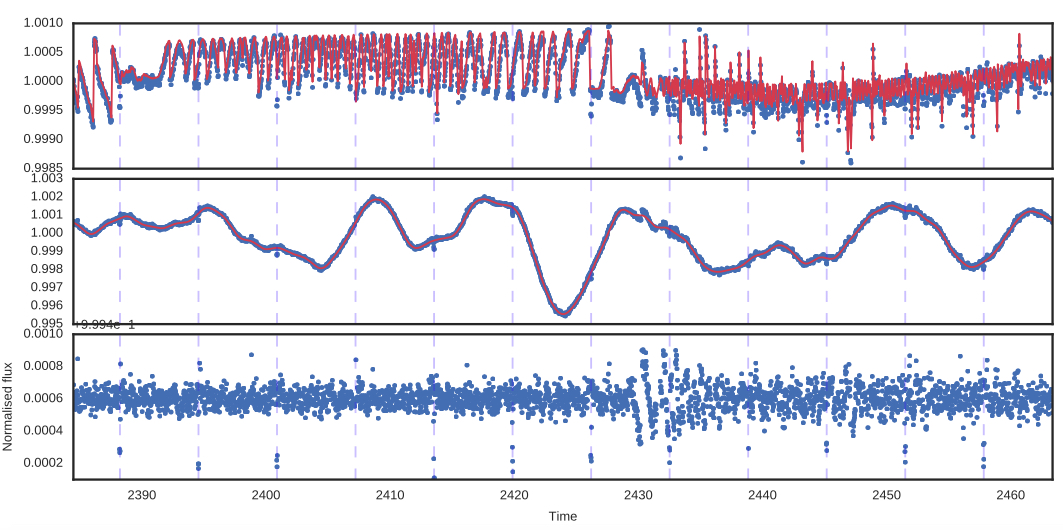
In our group's pipeline we use Gaussian Process models to detrend the flux time series with respect to the position of the star.

Raw - GP in position - GP in time

K2SC Figure

By subtracting the GP time and spatial components, we can find a transiting planet!
K2SC Figure 2
For sufficiently bright stars, though, light fills the CCD wells with electrons that spill up and down the column, ruining the photometry as they leave the aperture.
Kepler saturates on stars brighter than ~ 11th mag (log scale: 5 mag = factor of 100) - but we want to look at stars 10k times brighter.

Halo Photometry

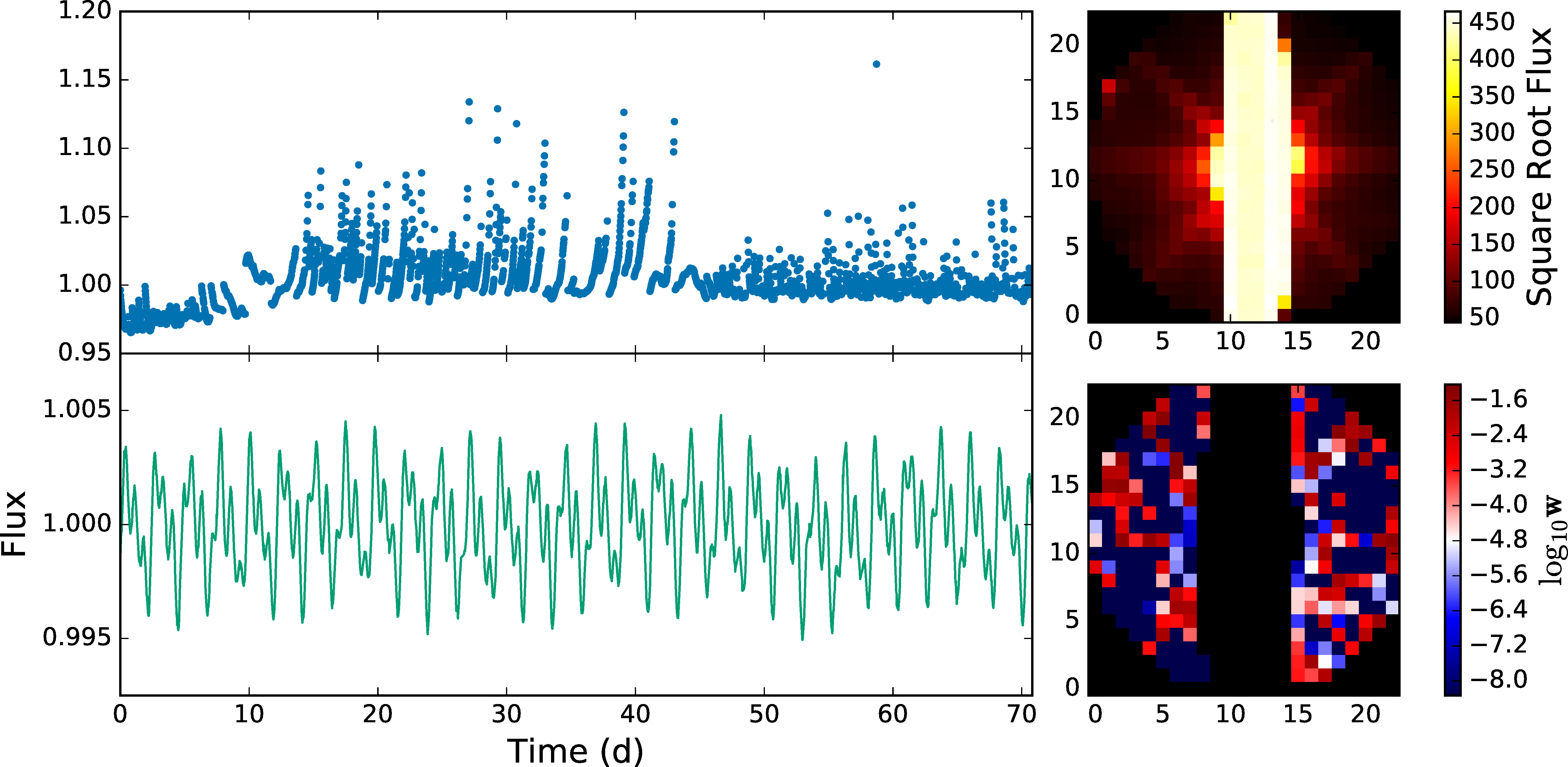
What if we just look at unsaturated pixels?
Flux \(f_i \) at cadence i is a sum over j pixels \(p_{ij}\) with weights \(w_j\):

\[ f_i \equiv \sum\limits_i w_j p_{ij} \]
To find the appropriate weights, we instead started by minimizing the Total Variation

\[\begin{align} TV \equiv \sum_i |f_i - f_{i-1}| \end{align} \] subject to constraints \[\begin{align}\forall_j w_j &> 0\\ \sum_{i=1}^{N} f_i &= N.\end{align} \]

This is the \(L_1\) norm or 'taxicab metric' on the derivative of the time series.

This has analytic derivatives you can compute with autodiff - easy to optimize.

All K2 Halo data are available online at github.com/benjaminpope/k2halo

Pleiades

Πλειάδες, the Seven Sisters

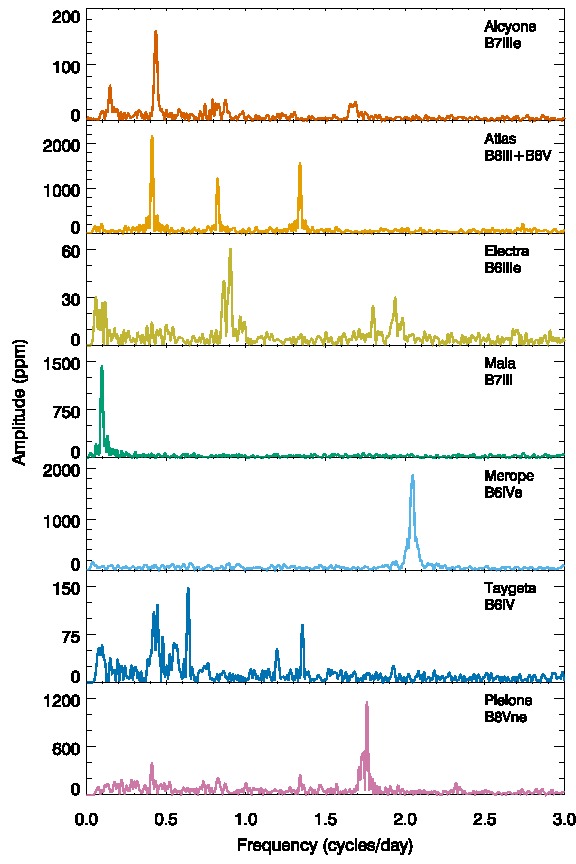
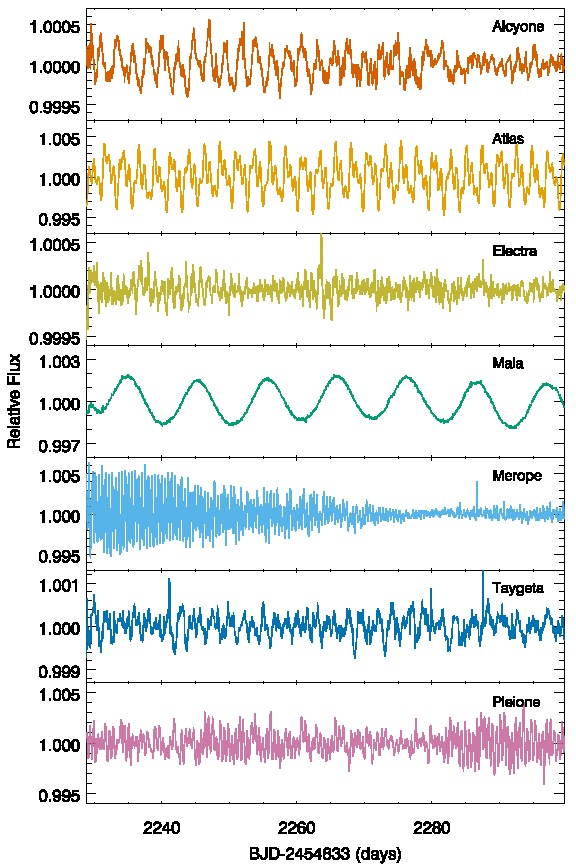
Alcyone, Atlas (dad), Electra, Maia, Merope, Taygeta, Pleione (mum)
Combined Figure

Atlas lightcurve: raw (top) and halo (bottom)
White, Pope et al., 2017

Combined FigureCombined Figure

Lightcurves of All Seven Bright Pleiades

White, Pope et al., 2017

Aldebaran

α Tauri

الدبران ,the follower

... follows the Pleiades!

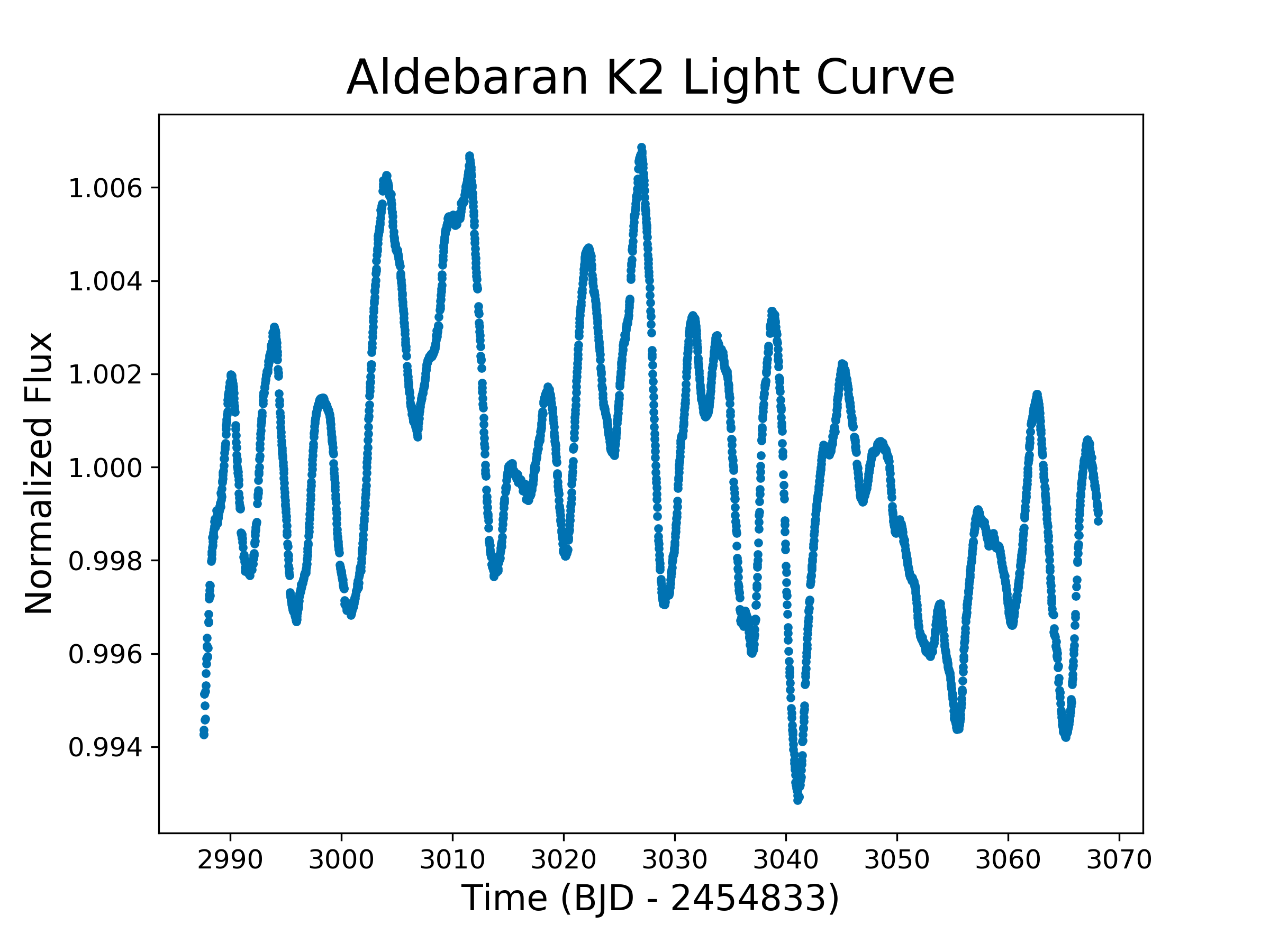
Hatzes & Cochran, 1993 claimed an early detection of a \(628.96 \pm 0.90\) d RV planet around Aldebaran - finally confirmed in Hatzes et al., 2015!

Detection of p-mode oscillations at 2.2 μHz
Aldebaran K2 Light Curve

Without this asteroseismology, we have

\[M = 1.27^{+0.24}_{-0.20} \, \mathrm{M_{\odot}}\] and age \(4.9^{+3.6}_{-2.0} \, \rm Gyr \)

With this new constraint, we have

\[M = 1.16^{+0.07}_{-0.07} \, \mathrm{M_{\odot}}\] and age \(6.4^{+1.4}_{-1.1} \, \rm Gyr \)

Using MESA models, we find that on the main sequence Aldebaran b had a semi-major axis of \(1.50 \pm 0.03 \) AU and Aldebaran had a luminosity \(2.0 \pm 0.7 \, L_\odot \)...

so Aldebaran b had an insolation comparable to Earth when its star was on the main sequence.

The Future

We have looked at all the bright stars in Kepler and K2 - but the TESS mission will deliver hundreds more. Can we find our nearest neighbours?
Can we use algorithms of this family to improve ground based astronomy?
What can we do with open data and open software more broadly in astronomy?